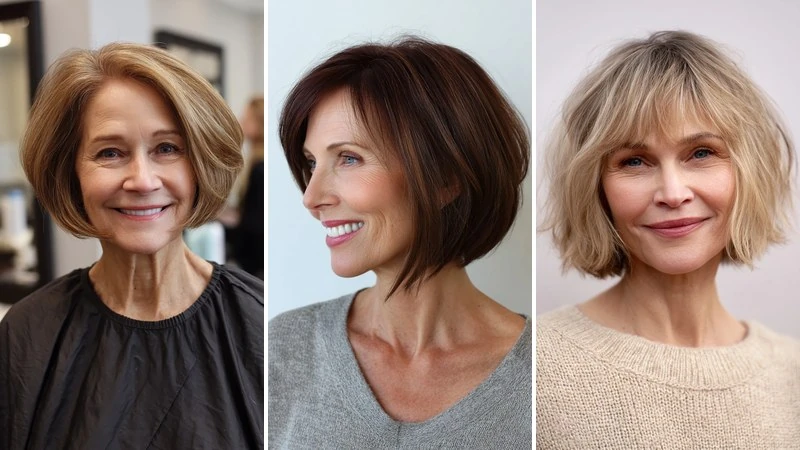
Scroll through any bob gallery and you see the same thing: a cut photographed on a young model with thick hair, not a pair of glasses in sight. Bob Hairstyles For Women Over 60 rarely look like that in real life. The women searching for them live with thinning hair and grey strands. Their glasses stay on; mornings leave no room for a long blowout. A short bob works when cut with real density in mind; a layered bob builds volume on fine hair. The styles I gathered are chosen for the next morning, not the salon photo.
These cuts follow the same logic as the advice on bobs for older women, where length and layering shift as hair changes. If thinning is your main worry, the thin hair styles over sixty address exactly that.
The 23 Bob Hairstyles For Women Over 60 That Actually Deliver — Sorted by Texture and Bangs
These 23 bob styles were chosen for how they move, settle, and hold after you sleep on them. No blowout‑session posing. We grouped them by texture and bang choice so you can find the one that matches your actual morning routine, whether you air‑dry or prefer a quick blow‑dry.
The No-Bangs Bobs: Soft & Textured
These bobs rely on natural wave and undone piecey finishes. They work best when you let them air‑dry most of the way and use product only where needed. No fringe means less styling time around the forehead — a blessing if you’re constantly pushing hair out of your eyes or adjusting your glasses.
The Undone Side-Parted Silver Bob

The soft layers in this chin‑length cut start at eye level so the face gets immediate movement, while the rest of the hair falls in loose, air‑driven waves. A deep side part throws volume across the crown without any backcombing. Apply a sea salt spray to damp hair, twist a few sections away from your face, and let them dry untouched — the shape sets itself. The natural silver and white tones blend together because the piecey texture breaks up any solid blocks of colour.
The Copper-Kissed Piecey Bob

Blunt ends are deliberately absent in this cut. Instead, the tips are razored into separated, feather‑light points that give the illusion of thicker hair. Layers start just below the cheekbones, leaving enough weight at the sides to keep the bob from looking shaggy. Mist a texture spray onto the mid‑lengths only — never the roots — and scrunch with your hands; too much product at the crown smothers the lift that this cut is built to create. The warm chestnut colour makes the piecey detail pop, especially under natural light.
The Vibrant Copper Curly Bob

Cut dry to respect the true spring of each coil, this curly bob stops right at the chin and rounds softly around the jaw. The layers are placed below the ear to prevent the silhouette from turning into a pyramid. Side‑parting directs the volume upward, not outward. Diffuse with your head flipped upside down until the roots are set, then let the rest air‑dry — the weight of damp curls won’t drag the crown flat. The bright copper shade, combined with natural texture, makes the whole look feel modern and alive. For more curly‑specific shapes, the same principles apply to wavy short styles.
The Buttery Blonde Beach Wave Bob

Darker roots melt into buttery blonde lengths, so the grow‑out stays forgiving. Loose, undone waves are scrunched in while the hair is damp, and the side part gives the crown a gentle boost. Gold hoop earrings work well here because the chin‑length ends don’t compete with them. If you have a halo of frizz around the parting, pat the area lightly with a dry fabric‑softener sheet — it kills static without adding weight or shine. The overall effect is relaxed and undemanding, exactly what a good everyday bob should be.
The Silver Side-Sweep Soft Bob

Layering is so minimal it’s almost invisible; the shape does the heavy lifting. A side‑parted sweep gently lifts the hair off the forehead and lets the ends flick softly against the neck. This is a cut that moves with you, not against you. If your hair tends to fall flat by midday, carry a travel‑size dry shampoo and puff it only onto the parting — one quick shake revives the whole style in seconds. The cool silver tone reads as intentional and crisp, never dull.
The No-Bangs Bobs: Sleek & Polished
If you like a smooth, controlled shape that holds a blow‑dry for days, these cuts are your territory. They lean on precise perimeters and soft internal layering so they never look dated. They wear especially well with a side part and a round brush.
The Salt-and-Pepper Precision Bob

The internal layers are sliced in sparingly so the perimeter remains blunt and clean, while still having enough movement to avoid helmet‑head. The overall shape reads as contemporary, not vintage—thanks to the subtle internal layering. The ends curve under very slightly, and a deep side part shifts the weight across the forehead. Use a paddle brush with a concentrator nozzle on your dryer; direct the air stream down the hair shaft to seal the cuticle — the mirror shine lasts until evening. The salt‑and‑pepper mix looks deliberate and polished, not patchy.
The Voluminous Silver Crown Bob

The layering concentrates at the crown, so you get height without sacrificing the solid look of the ends. Gently rounded tips keep the blunt perimeter from appearing severe. This is a cut that makes thin hair over 60 appear twice as dense. Set the top section in one large Velcro roller while you do your skincare; remove it and the lift stays through lunch without a single backcomb. The natural silver and dark streaks do the colour work on their own.
The Side-Swept Silver Crown Bob

A strong side part sweeps a generous section across the front, while the crown layers push upward. The ends curve inward, so the overall silhouette stays soft even though the cut is straight. The back is kept neat and slightly stacked to avoid a boxy rear view. To preserve the shape overnight, wrap your head loosely in a silk scarf — the smooth side keeps the crown from flattening while you sleep. The platinum blonde and silver blend gives the cut a high‑end, salon‑fresh look that lasts.
The Silver Sleek Chin Bob

Almost an one‑length bob, but with whisper‑thin internal layers to break the weight. The hair is tucked behind one ear, opening the face while still maintaining the clean jaw‑line. This style relies on polish, not product. Run a shine spray over a boar‑bristle brush and skim the top layer; it controls those wiry grey strands that tend to stand away from the head. Silver and white blend without a hint of yellow, thanks to the cool undertone. It’s the kind of bob that looks expensive even when your colour is entirely natural.
The Honey Blonde Blow-Out Bob

A classic salon finish where every end curves under with a round brush. The layers are subtle, so the outline reads full and bouncy. The honey blonde base with light ash highlights brightens the whole complexion. If you struggle with a traditional round brush, use a large hot‑air brush instead — one pass on each section and you’ll achieve the same curved‑in shape without the wrist ache. This is the bob that looks like you’ve just walked out of the chair, even on day three.
The Classic Salt-and-Pepper Chin Bob

The perimeter is cut blunt, but the crown is built with subtle layers that lift the shape away from the scalp. Silver strands streak through the dark brown base, so the cut doesn’t need any extra colour to feel current. When your natural silver starts to dominate, ask your colourist for a few lowlights in your original dark shade — it softens the regrowth line and the bob carries the contrast well. This shape doesn’t need heavy styling; a quick blow‑dry with a round brush and it’s done. The cut’s simplicity is its power; it never competes with your features.
The Tousled Silver Chin Bob

Though the hair is straight, the ends are razored to create a light bend that stops the style from looking rigid. The side part is soft, not severe, and the overall effect is clean but approachable. After washing, apply a volumising mousse to the roots only and tip your head forward to blast the roots dry — standing upright too soon kills the lift before it sets. Cool platinum silver makes the tousled texture look polished rather than messy. This bob works just as well for dinner as it does for errands.
The Bangs Bobs: Modern & Piecey
Bangs for older women don’t have to be heavy or schoolgirl. Here, the fringe is light, wispy, curtain‑style, or side‑swept — designed to blend into the bob without creating a solid block. These styles thrive on a bit of movement and are forgiving if you skip the blowout.
The Side-Swept Auburn Texture Bob

The fringe sweeps across the forehead and melts into layers that start at the cheekbones. The rest of the hair is cut with a razor to encourage a natural, undone wave — no curling iron needed. The deep auburn and mahogany tones amplify the movement. If you’re growing out grey, ask your stylist to weave a few warm highlights around the face; it makes the transition feel intentional and stops the regrowth from looking stark. For those ready to embrace the silver entirely, a low‑commitment colour strategy makes the process seamless. This cut wears its messiness like a decision, not an accident.
The Tousled Curtain Bang Bob

Curtain bangs part right at the centre of the brow and cascade outward, framing the eyes without covering them. The rest of the bob is layered to be piecey and airy, with a voluminous crown that doesn’t rely on backcombing. Twist the bang sections back with mini jaw clips while they air‑dry — this gives the swoop a soft set without ever touching a round brush or a hot tool. Platinum blonde with cool lowlights keeps the whole look light and modern.
The Side-Swept Rich Chocolate Bob

The side‑swept fringe starts short at the central hairline and gradually lengthens toward the temple, blending smoothly into face‑framing layers. One side is easily tucked behind an ear, exposing a gold drop earring for a little polish. When you tuck one side back, spray a light‑hold hairspray onto your comb and skim the top layer — it holds the shape without helmet stiffness. The warm chocolate brown reads rich and healthy, even under harsh bathroom light.
The Wispy Bang Buttery Bob

Instead of a solid fringe, you get wispy, broken‑up bits that dance across the forehead. The chin‑length cut is loaded with piecey texture, so the whole thing feels buoyant. Soft layers curve inward at the jaw, slimming the face from the front. Let the hair air‑dry 80%, then diffuse just the bang area for two minutes to give the wispies definition without flattening the rest. The buttery blonde shade with beige undertones brightens the skin without washing it out.
The Tousled Wispy Bang Bob

Wispy bangs that can be worn straight across or easily parted in the centre — your choice each morning. The textured layers throughout create a soft, undone finish that works with salt‑and‑pepper tones rather than against them. Rough‑dry this cut with your fingers until it’s 90% dry, then work a pea‑size amount of lightweight paste through the ends to separate them without clumping. The dark and silver threads add natural depth. It’s a low‑pressure bob that still reads as considered.
The Feathered Curtain Bang Bob

The ends are sliced vertically to create a feathery, see‑through perimeter that doesn’t look heavy even on fine hair. Curtain bangs lift away from the centre of the face, opening up the eyes while still softening the temples. The crown is cut with stacked layers to boost volume. To get those feathered ends, ask your stylist to point‑cut with the shears held vertically — it removes weight without making the outline look choppy. Light ash blonde with platinum highlights keeps the cut airy and modern.
The Bangs Bobs: Sleek & Defined
When you want a bang that makes a statement but still looks refined, these bobs deliver. The lines are sharper, the fringe more intentional. They pair well with glasses because the shape around the eyes is controlled. Expect a cut that holds its intention even after a long day.
The Espresso Blunt Bang Bob

A full, straight‑across fringe that sits right at the brows, combined with a chin‑length perimeter that curves under slightly. The blunt lines create a strong frame that immediately draws attention to the eyes. The rich espresso colour enhances the shine. Blunt bangs on mature hair need a dry fringe trim every three weeks — any longer and they start interfering with glasses and feel heavy. This is a bold, confident choice that doesn’t need elaborate styling to read as intentional.
The Side-Swept Platinum Bob


REVLON One-Step Hair Dryer and Volumizer
A classic hot-air brush for smoothing, volume and quick everyday styling.
Check Price on AmazonAs an Amazon Associate, Lady Lana Beauty earns from qualifying purchases.
A deep side part throws the silver‑platinum hair across the top, while the side‑swept fringe tapers into the longer face‑framing pieces. The shape is crisp but not stiff; it moves when you walk. Blow‑dry the fringe to the opposite side first, then flip it back — this creates a deeper sweep that won’t separate over the course of the day. Cool‑toned platinum makes this bob look crisp and deliberate, no matter how many grey hairs join the party.
The Side-Swept Golden Auburn Bob

Auburn base threaded with delicate blonde highlights brightens the complexion, especially around the front. The side‑swept fringe can be worn loose or tucked behind the ear without losing its position. The cut has just enough internal layering to remove bulk while keeping the silhouette sleek. When you blow‑dry, aim the nozzle downward along the front pieces — it prevents the bangs from flipping up and means less product is needed to hold them. This is a bob that looks as good at a restaurant as it does in the mirror.
The Asymmetrical Side-Sweep Bob

One side is noticeably longer, creating a diagonal line that lengthens the neck and draws the eye away from any heaviness at the jaw. The chocolate‑auburn hue adds richness, and the side‑swept bangs blend seamlessly into the longer layer. Keep the longer side from falling flat by spraying a dry texturising spray at the root of that section only — it props the hair upward without stiffness. This is a deliberately modern silhouette that works especially well with glasses because the asymmetry balances the horizontal frame line.
The Espresso Soft-Layer Side Bob

Interior layers are cut so softly they don’t disturb the sleek perimeter. The side‑swept bangs skim the brow and graduate into face‑framing pieces that angle down from the cheekbones. The dark espresso shade adds depth and makes the hair appear denser. For a quick morning reset, mist a little water onto a flat paddle brush and sweep the bangs into place — it reactivates yesterday’s product without the need to re-wet the whole head. This bob is a workhorse that goes from bed to breakfast with almost no intervention.
The Crucial Neck Check Before You Cut a Bob — and How It Changes After 60
Skin changes everything: After 60, the neck loses elasticity. A blunt nape can settle into horizontal creases instead of skimming them. A stacked or graduated back lifts the eye upward and keeps the line clean, even when the skin no longer sits flat.
Measure before you cut: Look straight ahead and check the distance from your earlobe to the shoulder tip. If it’s less than two finger widths, a bob ending mid‑neck will look disconnected from your shoulders. Go shorter at the back or let the front lengthen toward the collarbone. This moves the visual break away from the neck’s narrowest point.
The longer‑front illusion: Most guides tell you to cover the neck with one even hemline. I’d argue that’s often a mistake, because it frames the area you least want emphasised. A bob that’s slightly shorter in the back and angled forward tricks the eye into seeing a longer neckline, without losing the coverage you might want at the sides.
Use your jewellery as a guide: Where does your favourite pendant sit? A bob that ends exactly at that point draws focus to the collarbone — a naturally elegant line that stays defined with age. It shifts the whole silhouette upward.
Posture matters more than you think: Many women over 60 lean slightly forward. That tilt makes a blunt perimeter kick outward at the nape. Ask for light undercutting just at the neck; it removes the tiny bulk that causes the shelf effect, so the bob hangs straight even when you’re not standing at full attention. It’s one small adjustment that saves constant tucking.
Heat‑Free Styling Methods That Keep Bob Hairstyles For Women Over 60 Looking Fresh
Why heat stops working: Mature, fine hair loses moisture fast. The cuticle is often more porous, so a blowout can drop within a hour — especially in humidity. Heat‑styled shape rarely holds, and the constant drying stresses strands further. For a low‑maintenance look, you’re often better with air‑set techniques.
The 30‑minute crown lift: Damp hair only at the roots. Wrap three large Velcro rollers horizontally across the crown — no heat. Lay a silk scarf over them and go about your morning. By the time you dress, the rollers have set root volume that lasts all day. I’ve found this more reliable than any volume mousse on dry hair.
Natural wave without chaos: Twist small damp sections away from your face and clip them flat near the part line with tiny jaw clips. Let them air‑dry completely before you unclip. You’ll get soft movement without frizz, and the pieces fall into place instead of puffing out.
Stop rubbing, start scrunching: Towel‑rubbing roughs up the cuticle and invites fuzz. Switch to a microfiber cloth and scrunch only. Then apply a lightweight mousse — nothing with heavy butters. Gray strands tend to be coarser and will stand away from the head if weighed down. A foam keeps them soft and lifted.
Morning‑after fix: If you slept on a silk pillowcase, the bob often just needs a finger‑comb. For a crease, mist only the mid‑lengths with a continuous spray bottle — never the roots, never the ends — and gently re‑sculpt with your hands. It reactivates yesterday’s product without making everything damp and droopy.
When Your Gray Roots Outgrow Your Bob: The Low‑Maintenance Color Strategy
Length blurs the line: A heavily layered, slightly piecy bob at chin length breaks up the root demarcation simply because strands fall at different angles. The contrast between gray and your old color looks softer, not like a stripe. For women with thinning hair, this also adds texture that makes the part less visible.
Razored ends over blunt edges: A blunt cut creates a hard horizontal line that acts like a shelf — regrowth sits right on top and shouts for attention. Textured, razored ends diffuse that line. The eye reads movement, not a single colour block. If you’re growing out gray, this cut alone can buy you an extra two weeks between appointments.
Root smudging at the crown only: A colorist applies a semi‑permanent shade just on the part and temples, softening the contrast where you see it most. Women over 60 usually need this only at the crown — not a full head. It fades gradually and doesn’t require the maintenance of permanent color. This is the single technique that makes the grow‑out feel intentional rather than neglected.
Colored dry shampoo matched to your gray: Choose a shade that mimics your silver roots, not your old base. Tap a little onto a clean brush and dab it along the part — never spray directly. It camouflages regrowth for up to a week and adds a bit of texture at the same time.
Transition with a silver blend: Ask your stylist to weave a few thin, cool‑toned highlights through the front sections. As they catch gray strands, the whole bob starts reading as a refined silver blend rather than a color job that’s overdue. It turns the grow‑out into a style choice you can live with, and for many women, it’s the moment the bob finally looks like itself.
Why Your Eyeglasses Should Dictate Your Bob’s Angle
Avoid the double line: The heaviest point of your bob and the bottom edge of your frames create a visual band across your face. If they sit at exactly the same height, they flatten your features. Make the bob end clearly above or just below the frame edge. On an oval face, this keeps the proportions airy; on a square face, sinking the bob a finger‑width below a strong jawline softens the angles without adding width.
Cat‑eye frames and bob shape: The upswept glasseline clashes with inward‑curling ends. If you wear cat‑eye frames — a common choice for heart‑shaped faces — choose a bob that angles slightly outward at the jaw. A sharp forward graduation balances the lift of the glasses and draws attention down, which compensates for a narrower chin.
Progressive lenses and length: You need to read and look into the distance without hair falling into your line of sight. A bob that ends right at the temple arm keeps things clear. Any shorter, and you’ll constantly tuck strands behind your ears. For a round face, this length also avoids adding bulk at the cheeks, because the cut hangs just past the widest point.
Bangs that don’t battle the bridge: Curtain bangs part above the nose bridge and leave the lenses clean, while still softening the forehead. Straight‑across fringe usually smudges glasses and adds visual weight where you don’t need it, especially on long or rectangular faces. Cut curtain bangs to hit at the eyebrow when dry — no shorter. They’ll lift the eye area without interfering with your frames.
Stop temple dents: Glasses arms press into fine hair and leave a crease that lasts hours. Teasing only the crown area with a small brush lifts the whole bob up and off the frames, without backcombing the sides. This tiny lift works for every face shape, but on a diamond face it’s particularly useful because it widens the forehead just enough to balance the cheekbones without adding bulk.
The 3-Minute Morning Refresh Routine for a Bob That Slept Weird
This routine keeps all Bob Hairstyles For Women Over 60 looking fresh, but it’s especially useful for a Short Bob For Women Over 60, where a flat crown shouts louder than any frizz. I’ve tried dozens of morning fixes, and this is the only sequence that actually fits into a real morning — no blow dryer, no full restyle, just the spots that need help most.
Mist the middle layers only: Spray water onto the mid-lengths, never the scalp or ends.
A continuous mister reactivates yesterday’s product without soaking the hair. Fine, mature hair loses its shape the moment the roots get damp, so keep the spray well away from your parting. You want just enough moisture to wake up the cut — not enough to make the hair wet again.
Lift the crown with a cool shot: Use a 1‑inch round brush and your dryer’s cool button for twenty seconds dead centre.
That one spot corrects nearly all bedhead flatness. I skip the heat because cool air sets the root lift without over‑drying already fragile strands. If you do nothing else, this single move makes the bob look like it was cut that morning.
Smooth the surface, don’t rake: Rub one drop of argan oil between your palms and glide them down the outer layer.
This step replaces a silk pillowcase when you forgot to use one. Running your hands over the top layer — never raking through — calms fuzz without pulling volume from the roots. The oil sits on the cuticle, not the scalp, so it won’t make a Short Bob For Women Over 60 look stringy by lunch.
Velcro roller for the side bang: Place one vertical roller in the fringe and leave it in while you make coffee.
No heat, no fuss. By the time you’ve poured your cup, the bang has memory. For bobs with a side sweep, this tiny step brings back the angle that frames your glasses well above or below the temple, exactly like the looks in hairstyles for thin hair that rely on soft movement.
Last‑pass texture spray: One mist of a dry texture spray from arm’s length, nothing more.
This adds gritty separation without stiffness. It revives the piece‑y ends that make the cut modern, not severe. I reach for it because it hands back the airy finish a bob needs — without asking for a single minute of hot‑tool work.
FAQ
Will a bob make my double chin more noticeable?
Not if the bob ends slightly below the jawline and angles forward toward the collar. That diagonal line draws the eye outward, not down. Avoid a chin‑length cut that stops right at the widest point — it will emphasise what you want to soften.
How do I pick a bob that flatters my face shape, especially when I wear glasses?
For a round face, choose an asymmetrical bob with longer front pieces — the asymmetry breaks the width and lengthens. For a square face, softly layered ends that curve inward soften a stronger jaw. A heart‑shaped face benefits from a chin‑length bob with a side‑swept bang that balances a wider forehead. With glasses, always end the bob well above or below the frame edge so the two lines don’t clash across your face. Many modern bobs for older women use this exact rule to keep the look clean.
Do I really need to blow‑dry a bob every day?
No. Most bobs cut for mature hair are shaped to air‑dry with movement. Apply a lightweight sea salt spray to damp hair, twist sections away from your face, and let them dry untouched — the result is a piece‑y finish that doesn’t fall flat, even on fine strands.
Will a bob make me look older if my hair is completely gray?
A bob can make gray look strikingly intentional. Steer clear of tight, rounded “helmet” shapes and ask for soft, razored edges that let the different silver tones blend naturally. For inspiration, look at how short white hair can turn a solid block of colour into a luminous, modern finish.
What if my hair is thinning on top — will a bob expose my scalp?
Strategic crown layering and a side‑swept fringe add the illusion of fullness without weighing the hair down. Point cutting creates jagged ends that cast small shadows, hiding sparse areas — similar to the soft techniques used for thin hair in your 60s. Stay away from deep side parts that pull a fragile hairline taut.
How often will I need to get a bob trimmed so it keeps its shape?
Every five to six weeks. Older hair can grow unevenly and lose the clean perimeter faster than you’d think. Request a dry cut trim — it accounts for the natural shrinkage when hair dries, so you leave with the length you actually want, and it’s the same discipline that keeps bob hairstyles for women over 50 crisp.
I have naturally curly hair — can I still pull off a bob?
Absolutely. A curly bob should be cut on dry hair so the stylist sees exactly how each curl springs up. Layers must start below the ear to avoid a pyramid silhouette — the same principle you’ll see in short wavy cuts for older women. Diffuse on low heat, hover‑drying the roots only, and finish with a light coil‑defining creme.