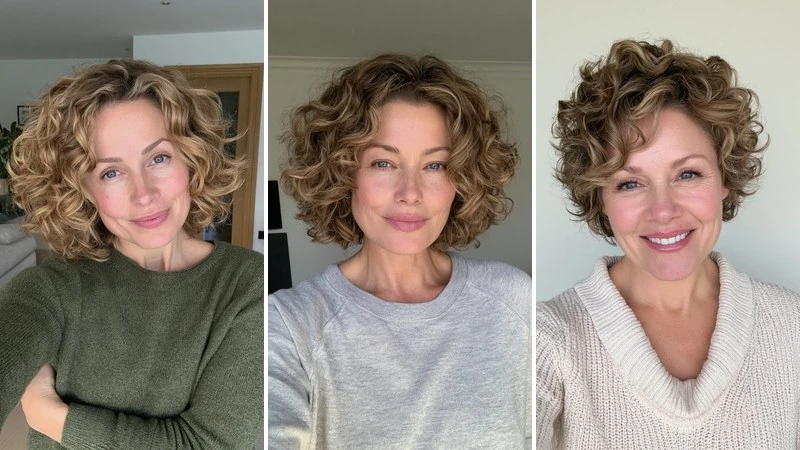
Most advice on short curly hairstyles for older women misses something crucial: your curls are not the same curls they were at forty. The ringlets loosened and the crown thinned, while the gray turned wiry. Yet most of the inspiration you see online keeps serving the same old shapes, cut for hair that no longer exists. Few lists are built around how curls behave after 50. The best low maintenance curly cuts accept the looser, drier texture you have now and work with it, not against it. These are the short natural styles I have gathered here.
If you are weighing a crop against a bob, the short curly cuts after 50 gallery is a better starting point. For looser patterns and transitions from relaxed to natural, the curly haircuts for older women collection is broader.
18 Short Curly Hairstyles For Older Women: Cuts That Work With Real Curls, Not Just Photos
From pixies that lift the crown without teasing to layered bobs that frame the face without dragging it down, these styles are chosen for how they actually behave on older hair—softer at the roots, thinner in places, greyer in others. No blowsy sets, no chemical straightening. Just modern shapes that respect your curl pattern.
The Pixie Cut Collection
Short, sculpted, and deliberately shaped for volume where you want it and ease everywhere else. These pixies rely on tapered sides and lifted crowns to draw the eye upward—ideal if you’re dealing with a softer jawline or thinner temples. If a pixie feels too drastic, a well-cut curly pixie makes the look intentional and modern, not like a surrender.
The Voluminous Silver Pixie With Tapered Sides

A salt-and-pepper pixie that uses the crown for height and the sides for restraint. The curls are swept off the forehead and directed upward, elongating the face—particularly useful for round or heart-shaped faces. The defined curls on top contrast with the close crop at the temples. If your stylist wants to thin out the top with a razor, politely decline; point cutting on dry hair preserves the curl’s natural clumping and stops it looking wispy. A pair of small hoop earrings, as shown, finishes the look without stealing attention.
The Platinum Textured Pixie With Wispy Edges

This cool platinum pixie works because the colour does most of the talking, while the cut stays soft and piecey. The crown is lifted but not stiff; the wispy curls around the temples keep it feminine. On grey hair, platinum can blend regrowth seamlessly. A purple shampoo is your friend here—use it once a week to knock out any yellow tones that can make short white hair look dull. The key is keeping the top layers long enough to show movement, so the crown feels airy, not solid.
The Tousled Salt-and-Pepper Pixie

This version leans into the natural mix of silver, charcoal, and dark lowlights—a look that can’t be replicated with a single-process colour. The volume sits high, the finish is undone, and the face is framed by soft, wispy curls that break up the hairline. To wake up a pixie like this, mist your hands with a lightweight spray and shake them through the crown rather than re-wetting the whole head—older hair takes ages to dry and you risk midday frizz. The cut itself does 80% of the work, which is why a low-maintenance shape matters more than any product.
The Burgundy Pixie With Faded Sides

Deep burgundy red on a curly pixie is striking, and the faded sides keep it from reading ‘costume.’ The undercut effect removes bulk at the temples and nape, while the defined curls on top create deliberate contrast. Ask for a shadow fade, not a skin fade—the gradual transition keeps the look soft and wearable, especially on greying edges. A pair of small silver hoops, as seen here, adds a bit of polish. Because the colour is intense, a sulphate-free shampoo helps it hold without stripping every wash.
The Honey-Tipped Pixie With Piecey Lift

This pixie blends a dark blonde base with honey and golden highlights, giving the piecey top layer extra dimension. The sides are tapered, the crown is voluminous, and the front wisps fall softly across the forehead. Leave two to three inches of length on top so the curls have enough weight to bend rather than spring straight up—too short and they’ll resist any styling. A dry texture spray at the roots, once the hair is completely dry, adds lift without damp product that flattens fine curls.
The Curly Bob Collection
Chin to shoulder, these bobs are layered to work with your curl pattern, not against it. They trade the heavy, helmet-like shapes of decades past for rounded silhouettes, soft face-framing, and strategic volume at the crown. Whether you’re embracing grey, adding a few caramel highlights, or letting your natural colour do its thing, a well-cut curly bob is the easiest route to a modern, low-maintenance style that flatters an older face.
The Dark Espresso Rounded Bob

A rich espresso brown bob with a rounded silhouette that lifts at the crown and curves gently inward at the chin. The side part adds instant volume, which matters when roots start to lie flatter with age. On hair that’s thinning at the crown, a side part does half the work of the cut itself—just flip it to the opposite side every few days to keep the lift going. The defined but not over-styled curls look polished without obvious effort, making this a solid choice for anyone who wants a dependable, workplace-friendly shape.
The Honey Blonde Bob With Golden Lowlights

Warm honey blonde with subtle light brown lowlights gives this chin-length bob a sun-kissed depth that reads youthful, not brassy. The side-parted layers are voluminous but undone, so the shape feels easy rather than set. With warm tones like this, swap your purple shampoo for a colour-depositing conditioner in caramel; it refreshes the golden notes without turning them ashy. The face-framing pieces curve toward the jaw, softening a square or heart-shaped face. Let the hair air-dry 70% before diffusing for the most touchable texture.
The Warm Chocolate Bob With Rounded Layers

A deep chocolate brown bob that uses rounded layers to build a soft, spherical shape from the roots down. The curls are diffused for controlled frizz but not over-defined, so the overall look stays lived-in. When diffusing, keep the hairdryer on a medium heat and stop at 80% dry—finishing with air prevents the ends from puffing out and ruining the round line. The layers start just above the ears and reach full expression at the crown, a placement that works especially well if your hair has thinned at the sides over time—a common shift after menopause that a cut for finer curls can address.
The Light Brown Bob With Golden Blonde Highlights

This chin-length bob combines a warm light brown base with golden blonde highlights that catch the light without overwhelming the curl pattern. The piecey definition, a hallmark of short curly styles that work past 50, comes from careful product layering, not heavy creams. Apply a lightweight foam to wet hair only at the crown, then gel from the mid-lengths to the ends—anything at the roots flattens the lift you’ve just created. The diffused finish leaves the hair with movement and a soft, modern texture that looks as good on day two as it does fresh.
The Salt And Pepper Layered Bob

Here, natural grey is the feature, not the problem. This chin-length bob embraces the mix with soft, side-parted layers that let the salt and pepper do its own highlighting. The volume sits at the sides and top, balancing a longer face shape. Grey hair is often coarser and thirstier—use a sulphate-free cream cleanser instead of shampoo, and skip daily washing to keep the curl’s natural oils. A quick blast with a diffuser on cool air sets the shape without puffing up the cuticle.
The Copper Curly Bob With Natural Bounce

Vibrant copper red on a chin-length bob is undeniably bold, but the undone texture and side-swept volume keep it from looking over-styled. The curls bounce with a natural-looking movement that suits a round or heart-shaped face. If you’re going this shade, have your trim done after the colour—copper dyes can temporarily swell the hair shaft, which changes the way the curl sits. A small set of hoops, as shown, is all the accessory you need with a colour this confident.
The Shoulder-Grazing Honey Bob With Ash Roots

This one sits right at the shoulders, with honey-blonde lengths and soft ash-brown roots that stretch the time between salon visits. The rounded volume comes from a centre part and layers that kick out slightly at the ends, adding movement without bulk. The longer the curly bob, the more crucial the trim schedule—waiting beyond seven weeks causes the ends to lose their spring and the whole shape to go flat. If you want a bit of length but prefer a low-maintenance routine, this hits the sweet spot.
The Chestnut Bob With Side-Swept Volume

A warm chestnut base with golden-caramel highlights, this bob uses a deep side part to sweep volume diagonally across the forehead. The effect draws attention to the eyes and adds height at the crown on one side. To set the deep part without pins, flip your head upside down and direct the airflow up toward the roots—gravity holds the parting line once you flip back. The undone texture means you can scrunch it with a little gel in the morning and go, no round-brushing required.
The Silver-Highlighted Salt And Pepper Bob

This bob pushes the natural grey palette further by adding silver highlights to the top layer, creating a brighter, more reflective look without touching the darker pepper tones underneath. The soft layers around the face accentuate the cheekbones, while the overall volume stays controlled. Ask your colourist for a ‘root shadow’ in a darker grey; it blurs the line of regrowth so you can stretch appointments to ten weeks. The cut relies on natural movement rather than definition, so a simple leave-in and air-dry is usually enough.
The Copper Bob With Wispy Fringe

Another take on copper, but what sets this bob apart is the soft, piecey fringe that grazes the brow without covering it completely. The layers are voluminous, the texture undone, and the overall effect is youthful but not overdone. Insist on point cutting for the fringe—thinning shears will shred the curl pattern and leave you with a frizzy, shapeless mess around your face. A light hold gel scrunched into the ends while damp is all this cut needs to look intentional by 8 a.m.
The Ash Brown Bob With Honey Blonde Tips

A medium ash brown base with subtle honey-blonde highlights that concentrate on the ends, giving a dipped effect without the heavy grow-out of an all-over colour. The layers are voluminous and side-parted, with the bulk starting around the cheekbones to lift the eye. Layers placed below the cheekbone are what keep this bob from mushrooming—if they start too high, you’ll wind up with a triangle shape by noon. A quick air-dry followed by a dry texture spray at the roots keeps the crown from collapsing.
The Ash Bob With Tousled Wispy Bangs

Here the ash brown base picks up golden blonde highlights and a set of light, wispy bangs that work with the curl, not against it. The crown is voluminous, the finish tousled, and the face is softly framed from temple to jaw. Because curly bangs shrink more than you think, always have them cut on completely dry hair; a wet cut can leave them an inch too short after they spring up. The overall look is a little undone, a little polished, and very forgiving on a rushed morning.
The Chestnut Bob With Defined Ringlets

This cut takes a warm chestnut brown, adds subtle golden undertones, and shapes it into defined, bouncy ringlets that hold their form all day. The rounded silhouette is classic but never stiff, thanks to layers that encourage the curls to sit in their natural groupings. The secret to this kind of definition is applying a light gel to soaking wet hair and not touching it until it’s completely dry—every poke breaks the curl cast. A final scrunch with a tiny bit of hair oil releases the hold without adding weight.


Kitsch Satin Heatless Curlers
A no-heat option for creating soft curls and waves while you sleep.
Check Price on AmazonAs an Amazon Associate, Lady Lana Beauty earns from qualifying purchases.
Why Your Curl Pattern Changes After 50—and How to Work With It, Not Against It
Follicle Changes: After menopause, lower oestrogen levels can alter the shape of the hair follicle, making it more elliptical and producing a drier, sometimes looser or tighter curl. The hair fibre itself becomes finer, so it struggles to hold the weight of heavy products.
Routine Failure: The same layering of leave-in, cream, and gel that once defined your curls now sits on top of the hair shaft. Buildup flattens the roots and makes ends look stringy. If your hair feels coated rather than conditioned, it is likely time to strip the routine back to one or two lightweight stylers.
Porosity Test: Low porosity becomes more common with age. To check, spray a little distilled water onto clean, dry hair. If it beads up and rolls off, your cuticle is tightly closed. This means you need to apply leave-in conditioner to damp hair before a gel, because water-based products need that film-forming humectant to lock in moisture—otherwise, the gel just seals in dryness.
Ingredient Swap: Glycerin-heavy products rely on humidity in the air to draw moisture into the hair. As our curls become drier and more porous, glycerin can actually pull moisture out in low-dew-point conditions, leaving a crispy mess. Switch to polyquats or flaxseed gel, which form a flexible, moisture-retaining film without depending on the weather.
Intentional Shaping: Most guides tell you to simplify your styling. I’d argue the better move is simplifying your cut. When density drops at the crown, too many short layers create a pyramid shape—flat on top, wide at the bottom. A cut with fewer, more deliberate layers, like a curly bob that holds its weight at the ends, gives intentional shape without the daily fight.
The Stylist Conversation: How to Get the Cut You Actually Asked For
Say This, Not That: Tell the stylist, “I want my curls to lie in their natural groupings, no round-brushing, no thinning shears.” This phrase immediately signals you are not after a set, pushed-back look. It shuts down the instinct to default to what many call the “old lady perm” shape.
Photo Marking: A picture of a young model with your curl type still fails because their density and spring differ from yours. Print the photo and circle the specific element you like—the way the side pieces taper, the length at the nape, the softness around the ears. That way, the stylist adapts the shape, not the impossible fullness.
Consultation Red Flags: If the stylist suggests relaxing your texture or wants to dry-cut without seeing how the curl bounces when wet, walk away. A cut on completely dry, styled hair works only if the stylist is trained to see the natural clumping pattern. For most, a dry dusting (trimming just the very tips on dry curls) preserves the best shape for thinning hair, unlike an aggressive Deva cut that can leave ends too wispy.
The Soft Leading Edge: Ask for a front face-frame that lifts without a fringe you must constantly trim. This “soft leading edge” is not a blunt bang; it is a gradual shortening of layers from the cheekbone forward. The placement changes with your face shape. On a round face, the shortest layer should start just below the cheekbone to avoid widening. A square face benefits from wisps that begin at the jawline to soften the angle. Heart shapes need the leading edge to sit at the chin to balance a narrow jaw. An oval face can carry slightly shorter temple pieces that lift the eyes without dragging the face down.
Color, Gray, and Curls: The Undiscussed Rules for Short Curly Hairstyles For Older Women
Yellowing Gray: Gray curls often pick up a brassy cast not just from minerals but because the cuticle becomes more porous and absorbs warm tones from styling products and air pollution. A purple shampoo alone rarely fixes this; a chelating treatment every six weeks removes the build-up that ordinary clarifying shampoos leave behind.
Single-Process Warning: An all-over permanent colour saturates each strand, weighing down the cuticle and making thin curly hair lie flatter. Instead, ask for a money-piece highlight around the face or a root-shadow technique. These add dimension without pulling the curl out of its natural spring, which is crucial for short curly cuts over 50 that rely on vertical lift.
Gray Blending for Tight Curls: For Type 3c to 4c hair, balayage painted only on the top layer preserves the bulk of the curl memory underneath. This “gray blending” avoids the stark line of demarcation that grows out harshly. The lighter pieces act like a frame, brightening the face without the maintenance of full coverage.
Hard Water and Frizz: If you live in an area with hard water, the mineral deposits coat gray strands, making them feel rough and look frizzy. A proper chelating shampoo—not a clarifying one—every four to six weeks strips that film, restoring softness and shine.
Same-Day Colour and Cut: Colour can temporarily swell the hair shaft, relaxing the curl slightly. Schedule your cut immediately after the colour service so the stylist cuts your hair in its post-colour state. That way, the shape accounts for how your curls will actually behave once you leave the salon.
The Morning Routine: Getting Out the Door With Short Curls in Under 15 Minutes
5-Minute Refresh: Fill a continuous mist spray bottle with distilled water. Lightly spritz the surface of your hair until it feels cool, not wet. Use a microfibre towel to micro-plop—squeeze sections gently upward—and in two minutes, you reactivate yesterday’s products without a full restyle. This works especially well on low-maintenance shapes that were cut to fall right into place.
Avoid Steam Refreshers: Older, more porous hair often reacts badly to steam. Too much moisture opens the cuticle too far, creating frizz instead of definition. Swap the facial steamer for a dry-oil mist that lightly reactivates your styling product. A single pump rubbed between your palms and scrunched into the mid-lengths revives the hold without adding weight.
Last-Hour Overnight Trick: You do not need to sleep in a full satin cap all night if it feels uncomfortable. Keep a satin-lined bonnet on your nightstand. When you wake up a hour before you plan to rise, slip it on and go back to sleep. That final hour protects the curl pattern from pillow friction and prevents the flat spot at the crown.
Parking-Lot Updo: Second-day jaw-length curls don’t pineapple well. Instead, gather the hair at the nape and twist it upward into a low French roll, securing with two small claw clips. Three quick twists and you have a tidy, lifted shape that works with curl texture rather than smashing it against your head.
Product Layering for All-Day Lift: Apply a lightweight foam only to the crown area on wet hair—this gives volume where it collapses first. Then, smooth a gel from mid-lengths to ends for definition. Skip the roots. Once the hair is completely dry, flip your head and mist a dry texture spray directly at the root. This prevents the 2 p.m. flat-hair look without adding stiffness.
The 3 Things to Write on Your Hand Before Your Next Cut
You don’t need a long list. A few specific words inked on your palm can save you from leaving the salon with a shape you didn’t want. Here’s what belongs on that hand—and a few reminders to carry in your head, too.
Cut on completely dry hair: Ask for the scissors to touch your curls only when they’re bone-dry.
Wet curls stretch and can shrink up to 30% once dry. A dry cut respects your curl’s real length and avoids the “shrinkage surprise” where a bob turns into an ear-length puff by evening.
No point cutting ends—blunt snips only: Tell the stylist to cut straight across the ends with the full blade, never with the tips.
Point cutting teases apart curl families and leaves frayed, frizz-prone tips. On graying hair that’s already coarser, those tiny split strands catch light and look wispy instead of intentional.
Ask for a geometric bob, not a stacked one: A stacked bob builds heavy weight at the back; a geometric bob distributes weight evenly through carefully placed, dry-cut layers.
Stacked shapes can mushroom on curly hair because all the volume sits in one spot. A geometric line lets curls fall into a clean vertical shape that doesn’t need styling tricks to behave. If you’re working with finer hair, a bob tailored for curls over 50 follows this same logic and holds its silhouette all day.
Photograph your best curl day before you go: Snap a picture the morning your hair clumps and springs the way you want it to every day.
Use your finger in the photo to mark where your hair naturally parts and where the volume disappears. Hand that image to the stylist and say, “Cut the shape around this pattern.” That’s far clearer than pointing to a model with different density.
Test the shape without styler in the chair: After the cut, ask to feel your hair with only a leave-in conditioner—no gel, no cream.
If the shape collapses or spreads oddly without product, the cut itself isn’t holding. That’s the moment to ask for a few more dry snips so you leave with a hairstyle, not a styling rescue mission.
Record the cutting method: Note whether the stylist used scissor-over-comb, slide cutting, or a dusting technique.
Next time you’ll be able to ask for exactly that method again—or avoid the one that left your ends too wispy. Sticking with the same technique is how truly low-maintenance curly cuts for older women stay that way visit after visit.
FAQ
Will short curly hair make my face look rounder?
Only if the bulk stops at your jawline with no vertical movement. For round faces, layered height at the crown plus a tapered nape pulls the eye up and down, elongating. Oval faces carry a chin-length curly bob well without shortening. Square faces benefit from face-framing layers that start at the cheekbone and break the angled line. Heart shapes work best when the nape is kept full and the top layers are shorter than the sides, balancing width at the forehead. The trick is asking for a geometric bob—not a stacked one—and insisting on dry cutting so the shape lands exactly where your face needs it.
Can I keep my curls short without looking like a Q-tip?
Yes, if the shape is deliberately asymmetrical or has a soft undercut that removes bulk from the bottom. The “mushroom” effect happens when tight curls are cut all one length with a single-guard trim. Instead, ask for more length through the front and visibly less weight below the occipital bone, so the silhouette tapers in rather than puffing out.
How often do I really need to have a short curly cut trimmed?
Every 5 to 7 weeks. After that, the ends lose their spring, the curl pattern collapses unevenly, and daily styling gets harder. Regular curly haircuts for older women that emphasize dusting over dramatic reshaping keep the shape fresh without losing length you’ve worked to grow into.
Are pixie cuts for curly hair too masculine on older women?
Not when they’re styled with a tapered neck and softer, longer pieces at the front that graze the temple and cheekbone. The secret is keeping a whisper of texture—never a sculpted, tight crop. A good short curly pixie should have what’s called a “soft leading edge” instead of hard, blunt lines; that whisper of movement keeps the look feminine without shouting.
What’s the biggest mistake older women make when going short for the first time?
Letting the stylist use thinning shears. They shred the curl’s natural clumping and create pieces that stick out, especially on graying hair that’s already coarser. If your hair has thinned at all, look into styles for older women with thin hair that rely on intentional shaping instead of internal texturizing.
How do I transition from a relaxer to natural short curls as an older woman?
Do a gradual “big chop” rather than cutting everything at once. Cut off relaxed ends in stages with a transition bob that blends the two textures, and rely on rod sets or flexi rods to even out the look while the new growth comes in. This staged approach lets you maintain a shape you still recognise while your curly style evolves toward full natural definition.
Will my hair get less curly as I age?
It can, and often does. The follicle may become less curved over time, loosening the pattern. What used to be a tight 3c bob might begin to read as waves. When that happens, adjust the shape rather than fight the new texture—often a slightly shorter length or a few more well-placed layers restore the volume you remember.