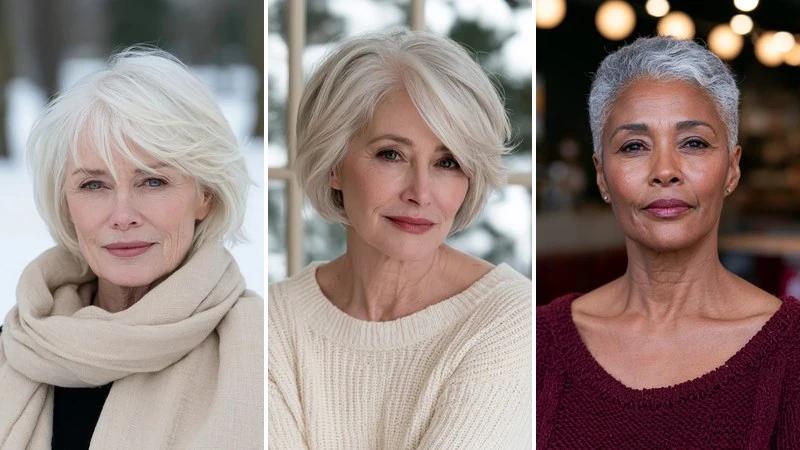
The hat comes off and the strands you lifted into shape at eight in the morning are already lying flat, welded together by static. Winter hairstyles for fine hair over 60 have to do more than look good in the salon mirror. They have to survive the cold air and dry indoor heating, and still look like themselves after a hat has pressed them flat. That is the problem most winter hair advice never really addresses: hair in your sixties has its own texture and its own way of reacting to the season.
How you handle the cold matters as much as the cut itself, and the companion piece on winter hairstyles over 60 takes the wider view. If your strands feel thinner than they used to, the notes on thin hair over 60 explain what to ask for in the chair.
21 Winter Hairstyles for Fine Hair Over 60, From Polished Bobs to Piecey Pixies
The difference between a cut that deflates by noon and one that lasts through hat season isn’t product — it’s shape. Below, 21 winter hairstyles for fine hair over 60, grouped by length and texture, each with one practical trick that actually works on real, thinning hair. If you’re ready to move beyond the one-length bob, these low maintenance styles are designed to work with your hair’s natural texture, not against it.
Polished Bobs That Hold Their Shape
When you want a finish that looks deliberate, these straight, rounded bobs add density at the ends and lift at the crown without needing a can of hairspray. The secret is often in a stacked bob shape that props itself up from the underside.
Layered Chin-Length Bob with Voluminous Crown

This chin-length bob relies on interior layering to create visible lift at the crown — exactly what fine hair loses in dry winter air. The ends are dried inward with a round brush, which adds weight at the jawline and keeps the silhouette clean. A deep side part redirects root volume across the forehead, making the hair appear denser. Use a mixed-bristle round brush with an ion-coated barrel when blow-drying to reduce static and seal the cuticle. The feathered layers around the face don’t compete with your bone structure; they simply soften. It’s a cut that looks as good emerging from a wool coat as it did leaving the salon.
Sleek Rounded Bob with Inward-Curved Ends

A rounded bob that skims the chin creates a full, dense hemline — even on thinning hair. The subtle layers are sliced underneath to prop up the surface, so the crown stays buoyant while the ends swing inward on their own. This natural salt-and-pepper shade proves that grey can be a textural asset rather than a challenge. Before blow-drying, spritz a lightweight thermal protectant only on the ends — too much product near the scalp weighs fine hair down and kills the lift you just created. The inward curve frames an oval or heart-shaped face well, pulling focus to the eyes rather than the jawline. It’s refined without feeling too “done.”
Soft Layered Bob with Undone Texture

This chin-length cut looks deceptively simple — it’s the “undone” finish that makes it work. The soft layers are cut with a razor on the ends to prevent bluntness, allowing the hair to curve naturally at the jaw when it dries. A bit of volume at the crown, achieved by blow-drying the roots forward with a vent brush, gives height without backcombing. Tuck one side behind your ear while leaving the other forward — the asymmetry instantly creates the illusion of fullness where fine hair tends to look thin. The cool ash-blonde pieces add depth, but the real star is the movement. It’s a cut that doesn’t punish you if you skip the round brush.
Polished Silver Bob with Rounded Ends

This sleek bob gets its refined edge from a perfect rounded perimeter — no wispy, tapered line that can read as “thin.” The weight of the cut sits at the ends, and the stylist has debulked the underlayers slightly so the silver-grey sits smoothly. Volume at the crown is created by over-directing the top sections forward as you blow-dry, then flipping them back into a deep side part. A few drops of lightweight hair oil rubbed between your palms and pressed into the mid-lengths will kill any freestanding static without making the hair greasy. The inward curve at the jawline softens a strong bone structure, and the platinum undertones reflect light like a mirror — making strands look thicker than they are.
Layered Bob with Side-Swept Bangs

The addition of a side-swept fringe transforms a basic bob into a frame that hides any thinning at the temples. The bang is sliced with a point-cutting technique so it’s wispy, not heavy, and it blends into the side layers without a hard line. The rest of the cut is classic: chin-length with soft internal layers that add body. To keep the fringe from separating in winter static, lightly mist a clean mascara wand with flexible-hold hairspray and comb it through the bang’s ends — no spray directly on the hair. The cool platinum tone brings brightness to the face, and the voluminous crown ensures the style doesn’t collapse under a scarf. It’s a look that feels modern without chasing trends.
Voluminous Layered Bob with Rounded Blow-Dry

This bob is a masterclass in using shape to cheat density. The layers are stacked at the occipital bone, giving the back a round, full profile that propels the rest of the hair forward. A round blow-dry with a medium-barrel ceramic brush creates that continuous curve from root to end, with the sides tucked slightly under the jaw. Let each section cool completely on the brush before releasing — it sets the hair’s “memory” so the curve holds even after a hat comes off. The silver-gray tone is even and luminous, with no brassy undertone to distract from the shape. This cut works especially well for oval and diamond faces, as the inward ends draw the eye up toward the cheekbones.
Textured & Lived-In Chin-Length Cuts
When you prefer a less deliberate look, these cuts lean on undone waves, piecey ends, and a bit of natural rebellion. They disguise thinning by making texture the star, and they often work with your hair’s natural wave rather than demanding a daily blowout.
Tousled Chin-Length Bob with Natural Waves

This cut makes the most of natural wave patterns without the need for a curling iron. The chin-length layers are cut to release the hair’s own bend, and a touch of silver highlight strengthens the peppery base. The crown stays lifted because the layers are shorter underneath, pushing the top layers upward as they dry. After washing, twist sections into four loose buns and let air-dry; undo them and finger-comb for a waved texture that lasts all day with no heat damage. The soft face-framing pieces widen the appearance of the cheekbone area, counteracting any hollowing that age can bring. It’s warm, lived-in, and entirely believable.
Wavy Bob with Outward-Flipped Ends

Flipping the ends outward instead of inward pulls the eye horizontally, which cleverly widens a narrow or long face. This silver-grey bob has a voluminous crown — achieved by directing the roots upward during blow-drying — and the soft waves are brushed through with a paddle brush to loosen them into a contemporary, relaxed shape. Wrap the mid-lengths around a 1.25-inch iron, but only clamp it for three seconds; too much heat on fine hair flattens the wave into a limp curve by lunchtime. The side part breaks up any possibility of that “helmet” look winter hats can cause, and the outward flip gives the style a bit of attitude without crossing into territory that feels too young. It’s confident, not contrived.
Icy Platinum Bob with Voluminous Waves

This icy platinum bob proves that an almost-white shade can add perceived thickness — bright tones reflect light and make each strand stand out. The waves are full and brushed-out, created with a large-barrel curling wand and then combed through with a wide-tooth comb. The side part anchors the volume over one eye, which lifts the entire face. Hold the curling wand vertically, not horizontally, when wrapping sections to create waves that bounce outward rather than droop downward as the day goes on. The layers curve inward gently at the jawline, so the silhouette stays soft. Because the platinum is so pale, roots in natural silver or dark grey aren’t a problem; they add root depth that helps the volume at the crown look denser instantly.
Textured Bob with Side-Swept Bangs

The bright platinum shade here acts almost like an accessory — it draws light upward, away from any thinness at the ends. The cut is a chin-length bob with piecey, razored layers that create a feathery outline. The side-swept bangs are integral; they blend into the side sections so there’s no abrupt line that can look choppy on fine hair. When blow-drying bangs, use a small round brush and direct them to the opposite side first, then flip them back — this builds lasting root lift that survives a winter scarf. The rest of the hair is dried with minimal tension to preserve the lived-in texture. It’s a white-blonde that looks refined, not brassy, and the tousled movement stops the style from ever looking stiff.
Vintage Wavy Bob with Deep Side Part

A deep side part immediately adds volume on its own — it’s physics: hair is lifted and stacked from the off-centre part. This silver bob takes inspiration from classic finger waves but softens them into wearable, brushable waves that don’t require setting lotion. The waves curve away from the face, which widens the upper third and balances a longer face shape. Pin each wave into place after setting with a light-hold mousse and let cool completely before unpinning — this “dry” set lasts hours without the crunch of gel. The smooth finish at the roots keeps it polished, while the ends move freely. It’s a nod to Old Hollywood that doesn’t feel like costume, but rather a confident style for an evening out in cold weather.
Wavy Bob with Air-Dried Texture

This cut is built for air-drying — the layers are cut to encourage the hair’s natural wave without leaving it shapeless. The silver-and-white blend adds dimension, and the tousled texture makes any flat spots from the morning feel intentional. Scrunch a lightweight sea-salt spray into damp hair, then use a diffuser on low heat only at the roots for three minutes; the salt spray sets the wave while the diffused roots provide lift without frizz. The face-framing pieces start at the cheekbone, not the chin, so they widen the middle of the face — a subtle trick that offsets age-related volume loss at the sides. This is the style for the woman who wants to wash and go, but with a cut that does the heavy lifting.
Feathered Bob with Airy Crown Volume

Feathering the ends rather than keeping them blunt gives this bob a lightness that stops fine hair from looking heavy and weighted. The crown is voluminous through interior layering, and the side part sweeps the silver-white strands across in a way that creates density at the hairline. Use a dry texturizing spray at the roots on day-old hair and work it in with your fingertips — it revives the crown without the wet-reset that can cause frizz in winter. The layers curve inward slightly at the jaw, but the overall feel is soft and buoyant, not rigid. Because the colour is a natural silver-white with cool undertones, it catches the low winter light well, adding a dimensional halo that thicker-haired women rarely get.
Short Pixies for Instant Lift
When hair is very fine, weight is the enemy. These pixie cuts for fine hair remove heaviness completely, letting what’s left stand up, curl out, or sweep softly — all with little planning. You’ll spend less time fighting static and more time forgetting about your hair entirely.
Curly Cropped Pixie with Silver Curls

Natural curl on a pixie cut can be a revelation for fine hair — each coil acts as its own support structure, giving the illusion of density. This salt-and-pepper pixie is cropped close at the sides, with slightly more length on top to let the curl pattern flourish. The tapered nape keeps it neat under a beanie. Apply a curl cream to soaking-wet hair and scrunch upward; then don’t touch it again until it’s fully dry to avoid disturbing the curl clumps that give volume. The soft layers around the hairline frame the face without covering it, drawing attention to the eyes and cheekbones. It’s a beautiful way to wear grey that feels celebratory rather than resigned.
Textured Pixie with Wispy Fringe

This pixie relies on piecey, separated strands rather than uniform density to look full. The cool silver blonde tone is bright without being icy, and the side-swept fringe softens the forehead while disguising any receding at the temples. The tapered sides keep the shape tight, but the top is cut with a razor for that “undone” finish. Work a pea-sized amount of matte paste between your palms and twist individual sections upward — this separates the pieces and gives the crown lasting lift without any sticky residue. Because the style is so short, hat head is almost non-existent; a quick finger-fluff restores the shape. It’s the complete low-maintenance winter cut for someone who wants to look polished in seconds.
Short Textured Pixie with Piecey Finish

This is the cut that makes thinning hair look deliberate — a very short, almost androgynous pixie with a textured crown and close-tapered sides. The salt-and-pepper colour adds a refined dimension that reads as modern, not ageing. When your pixie starts to look flat mid-day, flip your head over and blast the roots with cool shot for ten seconds — it re-activates the texturising product already in your hair. The piecey finish on top is achieved by rubbing a tiny amount of dry wax between fingers and pinching the ends. No need for a comb. The forehead is exposed, which can actually lift a face that might otherwise be dragged down by longer, weighty styles. It’s a confident choice.
Silver Blonde Pixie with Root-Lifted Crown

The beauty of this pixie is how the colour and cut work together: cool silver blonde with darker grey roots creates a shadowed depth that visually raises the crown. The cut is shorter on the sides, gradually increasing in length toward the top, where wispy, piecey layers are point-cut for a soft, not spiky, effect. Blow-dry the top section forward first, then flip it back with your fingers while still warm — it sets the volume direction and removes any cowlick tendencies. The forehead is left open, which elongates a round or heart-shaped face in the most flattering way. It’s a style that adapts to whatever you wear — under a beret, it stays crisp; without, it’s chic and unstudied.
Platinum Pixie with Dark Root Depth

The contrast between the platinum blonde and the ash-brown roots gives this pixie a built-in depth that fine hair desperately needs in winter. The cut is layered longer on top, with side-swept pieces that sweep across the forehead and direct the eye upward. The crown is intentionally left with extra length so it can be mussed up for volume. Instead of hairspray, use a powder-based volumizer at the roots — it gives grip without making the hair sticky, so the strands stay separate and full-looking all day. The tousled finish is achieved by rough-drying with a diffuser and then using fingertips to shape. It works particularly well with an oval or heart-shaped face, but the length on top can be adjusted to suit almost any bone structure.
Shoulder-Skimming Layers & an Elegant Updo
Not every winter day calls for short hair. These longer options keep length where you want it but use specific cutting tricks to stop fine hair from looking stringy. A shoulder-length cut with layers can still feel full if the ends are kept deliberately blunt or feathered, never razor-thinned.
Collarbone-Length Lob with Root Volume

This lob hits right at the collarbone — a length that feels substantial but doesn’t pull the face down. The soft, undone waves are concentrated on the mid-lengths, while the roots are kept loose and lifted. A cool silver blonde colour melts into natural grey roots, making grow-out invisible. After blow-drying, wind two-inch sections around a large curling iron held diagonally, then pull the ends straight as you release — this creates a wave that bends, not curls, and won’t droop in dry indoor heat. The face-framing layers start below the chin, so they don’t chop the face in half; instead, they soften the jawline and keep the perimeter airy. It’s the style for when you want a bit of length without sacrificing volume.


REVLON One-Step Hair Dryer and Volumizer
A classic hot-air brush for smoothing, volume and quick everyday styling.
Check Price on AmazonAs an Amazon Associate, Lady Lana Beauty earns from qualifying purchases.
Silver-Grey Lob with Outward Waves

A shoulder-length lob with a gentle outward wave at the ends brings a youthful gesture to silver-grey hair. The subtle highlights — just a shade lighter than the base — catch the light and add a sense of fullness. The roots are given a touch of lift with a texturising spray before drying, and the ends are flicked out with a flat iron for that relaxed, just-stepped-out-of-a-café look. Sleep with your hair in a loose, high ponytail secured with a silk scrunchie to preserve the outward wave overnight and avoid flat-backed “pillow head.” The face-framing pieces are soft and begin below the chin, so they never look wispy or thin around the temples. It’s a low-effort style for women who want a bit of movement without constant upkeep.
Low Voluminous Bun with Face-Framing Tendrils

This is the winter updo that doesn’t scream “occasion” — it’s soft, a little undone, and ideal for a night out or a holiday dinner, much like the styles you’d see for a Christmas gathering. The hair is swept back loosely, creating a voluminous crown, then twisted into a low bun at the nape. The real magic is in the tendrils: wispy pieces left free around the cheeks and jawline that soften the whole look and disguise any thinness at the hairline. Before pinning, backcomb just the hair at the crown with a fine-tooth comb and mist with dry shampoo — it gives the bun an anchored base that won’t slide down after a hour. The natural silver-and-white blend reflects candlelight well. It’s polished but never severe, and the loose pieces mean you won’t look like you’re trying too hard.
Why Fine Hair Falls Flat in Winter (and the 3 Product Swaps That Fix It)
The static‑humidity connection nobody explains: Fine, over‑60 hair has raised cuticles by nature. When indoor heating drops the humidity to desert levels, those cuticles can’t conduct away static electricity. Each strand becomes a tiny magnet, clinging to your scarf, your coat, and itself. That’s why a perfect blowout can collapse by the time you’ve locked the front door.
Ditch glycerin‑heavy stylers in cold weather: Most guides recommend glycerin for moisture. I’d argue that’s a mistake once the air turns dry. Glycerin pulls water from wherever it can find it — and in a heated home, that means it pulls moisture right out of your hair shaft, leaving strands more fragile. Swap to a lightweight mist with film‑forming humectants like polyquaternium‑11. It seals existing moisture without stickiness and keeps the cuticle smooth against static.
Your dry shampoo is a cold‑weather texturiser, not a cleanser: A starch‑based dry shampoo, applied to day‑old hair, creates micro‑separation between fibres. That internal grit breaks the static seal that flattens fine hair. Mist it underneath the crown, not just on top, then use your fingers to lift the roots. If you’re wearing a winter hairstyle that needs day‑long body, this swap alone can carry the style through a whole afternoon.
Why a boar‑bristle brush makes everything worse: Pure boar bristles are too soft to penetrate fine, thinning hair and create real lift at the root. Plastic bristles build static instantly. A mixed‑bristle round brush with ion‑charged nylon pins interacts differently — the nylon smooths the cuticle while the boar distributes natural oils, all while you blow‑dry tension into the root. That tension is what holds volume after the hat comes off.
The one ingredient that acts like a winter shield: Look for sprays containing cetearamidoethyl diethonium hydrolyzed rice protein. It deposits an anti‑static film so fine it feels weightless. A few mists over your finished style work like an invisible net, keeping strands separated even when the scarf rubs against your nape.
The Stylist Chat That Changes Everything
Why “just a trim” keeps you stuck: Fine, older hair loses density at the ends gradually. Every “quarter‑inch off” can actually leave a longer, wispier hemline that looks even thinner. Request a dusting on the perimeter — it removes only the very tips while preserving the shape. You’ll see the difference instantly in a bob that suddenly looks fuller.
The phrase that gets you real volume: “invisible layers.” I’m a firm believer in cut before product — if the shape doesn’t support lift, no spray can rescue it. Ask for interior layering: shorter pieces hidden beneath the surface that prop up the outer weight. This avoids the choppy, over‑layered look that can read as trying too young, and the body holds even on second‑day hair.
Why perms are never the answer (and what you say instead): Most stylists might suggest a perm for body. I’d say that’s a risk not worth taking. Modern perms on colour‑treated mature hair often lead to breakage and uneven curl. Instead, say, “I want a cut that gives me a wash‑and‑go texture without chemical dependence.” That steers the consultation toward razor‑cut ends or dry‑texturising techniques — a far safer route for a low maintenance winter shape.
The “Bob Trap” and how to escape it: A classic one‑length bob can sit heavy on thinning hair, emphasising sparse areas around the face. Ask for a softly debulked, collarbone‑skimming shape with a beveled under‑edge. This moves like a modern stacked bob but sits lighter, so winter coats don’t push it completely flat.
When to say no to heavy layering around the face: Over‑framing on fine hair can read as straggling, especially under a hat. Ask for face‑framing that starts at the tip of the nose and blends into the rest — no disconnected pieces. The result frames the cheekbone gently without losing density at the jawline.
How to Keep Lift Alive from 9 to 5 Using a ‘Gravity‑Defying’ Layering Trick
Apply volumiser where you’d never think: Spritz a lightweight root lift spray on the mid‑lengths and the underside of the crown, not just the scalp. When you blow‑dry, tension from the lower layer pushes the top section upward passively. Hair that looks like it has been backcombed — but hasn’t — rarely falls flat before lunch.
The 30‑second clip‑set that costs nothing: After blow‑drying, grab three small velcro rollers. Wind the front hairline section backward and two smaller crown sections straight up. Mist with a flex‑hold spray, leave them in while you dress, then remove. The cool‑set lift lasts through hat removal because the hair shaft has actually taken on a new set — no heat damage involved.
Face shape matters for roller placement: Where you position those rollers changes how your face reads. If your face is round, place the front roller further back from the hairline; lifting the crown elongates, while too much height at the temples widens. A heart‑shaped face benefits from a roller only at the lower crown — never near the temples — to balance a narrower chin. Oval faces can use the front roller just behind the hairline for a soft, balanced lift. For a square jaw, add a fourth roller on the side part to lift the parietal ridge, which instantly softens the angles without adding bulk.
Your hairspray might be working against you: Aerosol hairsprays become tacky and readhere to compressed hair under a hat, creating a flat mat. Use a powder‑based volumiser or a flex‑hold mist that stays malleable. If you’re wearing a winter hat, this one swap prevents the plastered‑down effect many women dread.
The “mid‑day whoosh” that resets shape: Flip your head over and blast the roots with a travel‑size dryer on the cool‑shot setting for ten seconds, then gently finger‑rake from the nape upward. No mirror needed. It breaks the static seal that builds throughout the morning, especially after you’ve been sitting under office heating.
Avoid the death‑drop at the part: Shift your part daily — even a quarter‑inch changes how sebum weighs roots down. This simple trick delays the greasy flattening that winter scarves accelerate, keeping the crown feeling fresh longer.
How to Keep Your Winter Hairstyles For Fine Hair Over 60 Looking Fresh Between Washes
Skipping washes is a volume tool, if you do it correctly: Hair with a tiny bit of natural oil has far more body than squeaky‑clean strands. Apply dry shampoo at night before bed — while you sleep, it absorbs sebum, and you wake up with built‑in texture, not a powdery cast. For a low maintenance cut, this routine means you can often stretch washes to twice a week without looking greasy.
The towel trick nobody teaches: After towel‑drying, wrap hair in a microfiber turban and press — never rub. Then take a pea‑size amount of air‑dry cream, rub your palms together, and scrunch upward into the mid‑lengths only. This pre‑sets bends that revive on non‑wash days with a little steam. Your hair remembers the shape, so you don’t have to re‑create it from scratch.
Silk isn’t just for your skin; it’s a cold‑air fighter: A silk pillowcase reduces the friction that roughs up cuticles in dry air, but also prevents the micro‑tangles that make fine hair look messy by morning. Look for a silk‑lined winter beanie, too — it stops hat‑head compression while keeping your style intact. If you’re committed to a winter hairstyle that needs to survive the school run or an afternoon walk, this small change is worth the investment.
The scarf‑friction fix: Before draping a wool scarf, lightly mist a leave‑in conditioner with an anti‑static agent like cetrimonium chloride onto the inside of the scarf, not the hair. Let it dry. It neutralises the charge transfer without weighing down fine strands. Your hair stays smooth and separated even after you unwrap.
Revive shape with steam, not water: A facial steamer or the ambient steam from a hot shower can re‑plump fine hair’s natural wave without making it wet and heavy. Lean in for thirty seconds, then scrunch. The moisture reactivates the air‑dry cream you applied days ago, and the shape bounces back without any product build‑up.
The Cold-Weather Accessory That Adds Instant Volume (No Teasing Required)
Slide It Back: Position a softly padded, velvet‑wired headband one to one and a half inches behind your hairline—not right at the edge.
That placement lifts the front crown cleanly, vanishing under the top layer so it looks like your hair has natural height. If you wear a short layered cut, this trick amplifies the crown even more. I haven’t backcombed my crown in months since I discovered this—it lifts without breakage.
Lighter Than Your Roots: Choose a headband in a shade one tone lighter than your root colour.
This creates a soft shadow‑light contrast that visually thickens the hairline and draws the eye upward, away from any thinning areas. A pearl grey, champagne, or soft silver works well against salt‑and‑pepper or pure silver hair, blending rather than shouting.
The Magic Knot: Thread a small silk scarf through the headband at your temple and tie it loosely at the nape, underneath your hair.
The gentle backward tension lifts the sides outward, breaking the helmet shape that winter hats often mould into your style. It stays completely hidden until you twist your head—and the silk glides against your collar without static.
Slim Over Chunky: Avoid heavily embellished, chunky headbands—they compete with delicate hair. Opt for fine micro‑pleats or a slim metal band with a soft grip backing.
Fine hair can look overwhelmed by thick fabric or big stones. A narrow, flexible band frames your face without stealing the show, and the grip backing keeps it from slipping down the back of your head on windy days, so you aren’t constantly adjusting.
Mind the Grip: Look for a soft, silicone‑like grip backing—never sharp teeth or tightly coiled springs.
Fragile, ageing strands snap easily under tension. A velvet‑wired band with a smooth, slightly tacky underside holds without pulling, and it won’t leave behind those tiny broken hairs along your hairline that signal too much friction.
FAQ
Will short hair make me look older if I have fine hair over 60?
Not if the cut has soft, irregular lines. A blunt, heavy‑ended bob can drag features down, but a short style with invisible layers and a wispy nape lifts the whole silhouette. The crown needs to stay the highest point—short hair does that easily on fine strands.
How do I keep my hair from going flat under a winter hat?
Use a beanie with a looser crown, ideally lined with a scrap of silk you stitched in yourself. Before you pull it on, mist a dry‑texture spray at the crown only—the hat will press it down, but the gritty layer stops strands fusing flat. When you remove it, flip your head over and scrunch sections upward to re‑separate.
What’s the easiest winter hairstyle for fine hair over 60 that requires no heat?
A soft, twisted French roll pinned at the nape with small jaw clips takes two minutes and no heat. Gather hair loosely, twist upward, secure against the occipital bone—the weight holds the twist. Leave a few short pieces free around the ears; they dry with a natural bend that reads as intentional texture.
Can I wear bangs if I have fine hair over 60 and a cowlick?
Yes—but ask for curtain bangs that are vertically sliced into the hair, not cut straight across. This shear‑slit texture makes them light enough to circumvent a cowlick’s parting. The soft middle part hides resistance, and the ends blend without fighting growth patterns.
Why does my fine hair get so static in winter and how do I stop it immediately?
Cold, dry air strips moisture from your hair, leaving cuticles unable to conduct away electrical charge. An immediate fix: lightly run an unscented dryer sheet over the outer layer—it neutralises static without flattening. For long‑term control, switch to a sulfate‑free shampoo; sulfates strip the natural fatty acids that keep cuticles slightly sealed.
Is it okay to have long hair after 60 if it’s fine?
Only if the ends are kept deliberately tapered—a blunt hemline on fine hair looks transparent and stringy. A mid‑back length with a deep U‑shape and razor‑erased ends can look full if layers are cut almost invisibly from the chin downward, never from the top. Avoid heavy layering on top; it steals weight from the ends.
How do I make my thinning hair look thicker without damaging styling?
Use an opaque‑mist root touch‑up powder matched to your scalp tone, not your hair colour. Apply with a small brush only where scalp shows through—it instantly widens the appearance of density at your parting. It rinses out with shampoo and avoids the breakage that comes from teasing or heavy hairsprays.
How do I know if a jaw‑length bob will suit my face shape?
For a round face, ask for layers that start below the chin and a length that just grazes the jawline—this elongates. A square face needs soft, wispy ends around the jaw, never a blunt line, to relieve angles. If your face is heart‑shaped, choose a bob with a slightly stacked under‑edge; the fullness at the chin offsets a wider forehead.