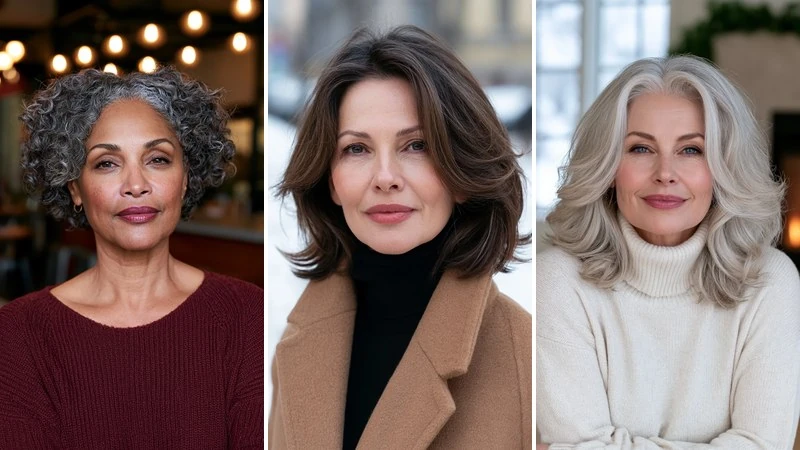
There is a particular kind of frustration that comes with pulling off a wool beanie in January and finding your hair flattened against your scalp, crackling with static. Winter Hairstyles For Women Over 50 have to work harder than summer styles, because mature hair is thinner and more porous, with a cuticle that grabs at dry indoor air. Most winter hair guides assume the hair you had at thirty, which simply isn’t the hair you have now. The cuts that actually work build volume at the roots and calm the electrical charge, so the style survives without constant upkeep.
If your hair has noticeably thinned, a good cut matters more than any product — I’ve covered flattering haircuts for fine hair before, and those same principles carry into winter. And if you wear hats, these hat-friendly styles for grey hair show which cuts hold their shape best under wool.
16 Winter Hairstyles For Women Over 50, From Pixie to Lob
Every cut here was chosen because it handles winter’s static, hat compression, and dry air without constant restyling. They’re organised by length and texture — pick the shape that matches your natural hair and the level of effort you’re willing to give.
Pixies That Keep Their Shape
Short cuts get a bad reputation for leaving you with nowhere to hide, but these pixies prove they’re the most resilient winter shape around — no heavy lengths to flatten, no static halo to tame.
The Lifted Curly Pixie

The Lifted Curly Pixie relies on natural curl to create height at the crown and softness around the face. The sides are tapered close, but the top stays longer — enough to let silver-grey ringlets frame your eyes and cheekbones. There’s no heavy layering, so the cut feels light, even under a hat. Apply a curl cream to damp hair and let it air-dry — winter heating dries out curls if you diffuse them every day. The result is a confident, low-fuss shape that doesn’t fight your texture.
The Piecey Silver Pixie

The Piecey Silver Pixie keeps its shape with a tapered nape and slightly longer top layers that sweep across the forehead. The cut is all about separation — each section stays distinct, so the hair looks fuller than it really is. The cool silver-blonde shade with a darker root adds depth, but the real trick is the texture. A tiny dab of matte paste worked through dry ends gives that piecey separation without heaviness — no need to wash it out every day. It’s a modern cut that wakes up your face without heavy maintenance.
The Side-Swept Pixie

The Side-Swept Pixie in dark ash brown brings depth and movement to fine hair. The side-swept bangs soften the forehead and blend into tapered sideburns, so the face stays open. The crown is cut with hidden shorter pieces that lift the top hair off the scalp — a detail that matters most when you pull off a woolly hat. I’d pick this cut over a stack of volumising products any day — the internal layering lifts the root, and that’s a job no mousse can replicate consistently. After removing your hat, flip your head over and tousle the roots with your fingers — the cut’s built-in scaffolding brings volume back in seconds. This is a feminine, modern shape that needs very little from you.
Sleek Chin Bobs For Everyday Polish
A chin-length bob is the workhorse of winter style. These cuts rely on clean lines and internal volume to resist the flattening effect of scarves and collars.
The Voluminous Blowout Bob

The Voluminous Blowout Bob brings swing and softness in equal measure. Cut to chin length, the layers are concentrated around the crown to lift the roots, while the ends curve gently inward toward the jaw. The warm chestnut colour helps, but the shape does most of the work. Blow dry with a medium round brush on a lower heat setting — high heat can crisp fine winter hair, killing the bounce before it settles. Honestly, this cut gives such solid structure that you could even air-dry and still have shape. It’s a polished look that lasts through a day of dry indoor air without falling flat.
The Sleek Silver Bob with Wispy Bangs

The Sleek Silver Bob pairs a precision chin-length bob with soft, wispy bangs that thin out toward the temples. The rounded ends hug the jaw without looking heavy, and the crown is subtly lifted for a clean profile. Because the surface is smooth, it reflects winter light well, but that same smoothness can turn to static cling without the right finish. Run a single drop of lightweight hair oil through dry ends before going outside — it neutralises the static charge that wispy bangs catch from scarves. This is a refined look for days when you want polish with little planning.
The Textured Bob With Side-Sweep

The Textured Bob With Side-Sweep combines a soft, face-framing cut with cool platinum blonde shades that add dimension. The nape is tapered to remove bulk, while the crown stays voluminous and piecey. The side-swept bangs blend into the longer front sections, breaking up a wide forehead. If your hair is fine, scrunch a mousse into damp hair and let it air-dry — the piecey texture settles naturally, and you avoid overworking the cuticle with a brush. It’s a youthful shape that doesn’t require a fresh blowout every morning, making it a smart choice for busy winter weeks.
The Rounded Charcoal Bob

The Rounded Charcoal Bob is all about gentle, inward movement that frames the face softly. The cut sits at chin length with a voluminous crown and ends that curve under just enough to create a cohesive line. The natural charcoal grey with lighter salt-and-pepper streaks adds texture without colour upkeep. The shape does more of the work than any product could — that rounded silhouette holds its own against winter gear. Wear a satin-lined beret over this style — the smooth interior keeps the rounded silhouette intact instead of squashing it flat against your scalp. This is the kind of bob that looks expensive and feels comforting, perfect for chilly days when you want a pulled-together look that lasts.
Curly and Shaggy Bobs That Move
When your hair has natural curl or you’re willing to encourage a bit of undone texture, these chin-length styles deliver bounce and movement that actually thrive in dry air.
The Voluminous Silver Curly Bob

The Voluminous Silver Curly Bob embraces natural salt-and-pepper curls with a side part that allows for soft, face-framing width. The cut is layered to encourage curl formation without adding bulk, so the shape stays bouncy rather than triangular. Because the curls are defined, there’s no need for daily styling — just a refresh with a mist. Diffuse on low heat and stop before the curls are completely dry — the residual moisture keeps the cuticle sealed, which means less static later. It’s a cheerful, confident shape that goes from the office to a weekend walk with ease.
The Platinum Shag Bob

The Platinum Shag Bob brings a modern, undone edge to chin-length hair. It’s cut with curtain bangs that part down the centre and blend into piecey layers, creating movement even when the hair is fine. The cool silver colour makes the whole look feel intentional, but the true strength is the cut’s ability to hold volume after a hat. Spray dry shampoo into the roots before bed, not in the morning — overnight absorption gives better texture and less white cast on silver hair. There’s no perfect finish required, so it works as well on day three as it does freshly styled.
The Centre-Parted Curly Bob

The Centre-Parted Curly Bob takes a classic chin-length cut and lets natural salt-and-pepper curls do the talking. The layers are concentrated around the face to highlight the cheekbones and jawline, while the centre part gives a balanced, open look. The undone texture feels soft and touchable, not stiff. After air-drying, gently pull apart the curls with your fingers at the roots — it breaks up any clumping and adds an inch of lift without product. This style celebrates natural movement and needs very little heat, making it a friend to fragile winter strands.
The Layered Curly Bob

The Layered Curly Bob is cut to chin length, with soft layers that create volume around the temples and jaw. The natural salt-and-pepper mix shows a spectrum of silver and dark tones that add depth without colour processing. The curls are defined but not rigid, keeping a soft silhouette that won’t look crunchy. I’ve yet to meet a curl cream that does more for definition than a good layered cut, and this one proves that. Apply a water-based leave-in conditioner by scrunching upwards — water-free creams can sit on top and flatten the hair by midday. It’s a flattering, low-maintenance choice that protects the hair by minimising heat and aggressive brushing, which thin winter hair really doesn’t need.
Shoulder-Length Layers With Natural Volume
Shoulder-length hair can feel weightless in winter, but with the right layering it gains volume and shape. These cuts keep length without sacrificing lift.
The Soft Platinum Lob

The Soft Platinum Lob is cut to shoulder length with long layers that curve around the jaw and cheekbones. The centre part keeps the look balanced, while the waves are blown out and then lightly curled at the ends to create movement. The cool silver tone works as a neutral that brightens winter skin, but the cut will work in any colour. Wrap only the mid-lengths to ends around a 1.5-inch iron and leave the roots alone — the natural root lift will hold longer than if you curl from the top. This is an elegant, grown-up shape that feels fresh without being trendy.
The Espresso Shoulder Bob

The Espresso Shoulder Bob brings richness with its deep brown base and subtle mahogany warmth. The layers start at the jaw and cascade down, framing the face softly. A side part and volumised waves create body that feels generous, even on fine hair. The key is the way the layers are cut: they remove weight at the bottom so the hair swings rather than hangs. Sleep on a silk pillowcase — the smooth surface keeps the waves intact and reduces the friction that causes winter tangles and breakage. This cut works for days when you want to look put-together without spending a hour at the mirror.
The Long Silver Layers

The Long Silver Layers sit just at shoulder level with soft, face-framing pieces that start below the chin. The waves are loose and undone, moving naturally rather than being set in place. This is a cut for women who want to keep some length while still having shape. The silver and grey blend looks intentional and luminous, especially under grey winter skies. Mist a salt spray that contains hydrating glycerin onto damp hair before air-drying — it creates grip without the straw-like feel winter air can amplify. It’s a low-maintenance choice that relies on the hair’s own character, not heavy styling.
The Collarbone-Length Lob

The Collarbone-Length Lob has an easy, undone feel that suits the natural movement of silver and salt-and-pepper hair. The layers are concentrated toward the front, leaving the back full and swingy. Face-framing pieces soften the jawline without hiding the face. There’s no set curl pattern — just soft, air-dried texture that looks like you woke up with good hair. Use a wide-tooth comb on dry hair instead of a brush — it separates the waves without breaking the hair shaft, which is more brittle in cold conditions. This cut is for women who want length but refuse to sacrifice volume or health.
The Deep Side-Part Lob


OUAI Leave-In Conditioner
A lightweight leave-in conditioner for detangling, smoothing and heat-prep routines.
Check Price on AmazonAs an Amazon Associate, Lady Lana Beauty earns from qualifying purchases.
The Deep Side-Part Lob creates drama and volume by sweeping heavy silver-grey waves to one side. The layers are long and blended, starting below the chin, so they draw the eye upward toward the eyes. The cut is voluminous but not heavy, thanks to internal layering that lifts the top without shortening the bottom. When your roots start to flatten, flip your parting to the opposite side — the hair springs up automatically because it’s been sitting in the opposite direction all day. It’s a refined, feminine shape that works as well for a dinner out as it does for a casual walk through frosty streets.
Why Winter Static Is Worse After 50 — and How to Choose Cuts That Calm It
Porous Cuticles: By the time you reach your fifties, the hair cuticle often lifts slightly, like a pinecone opening in dry air. This higher porosity means your strands grab whatever moisture they can find — and when indoor heating has stripped the air to desert levels, they cling to themselves and every scarf in sight. That electrical snap you hear when you pull off a hat isn’t a personality flaw; it’s physics built into the structure of mature hair.
The Friction Factor: A haircut’s shape dictates how much surface area rubs together. Blunt ends create a solid wall of friction — an one-length bob can turn into a clingy mess within minutes of stepping indoors. Soft, textured, or beveled edges break up that surface contact, so the hair doesn’t build the same charge. A layered pixie, for instance, distributes weight and reduces the points where strands can tangle and spark. You can chase static with a dozen sprays, but I’d rather you fix the cut first, because the right shape removes the friction that generates the charge. For round faces, keep the ends around the jawline wispy and beveled rather than a sharp line — that soft perimeter cuts static without adding width. Heart-shaped faces benefit from a textured pixie with feathery edges that stay grounded rather than flying outward at the temples. If your face is long, a collarbone-length shag with internal layering still reduces surface friction while balancing proportions.
Ingredients That Quiet the Charge: Look for styling products that list behentrimonium methosulfate or cetearyl alcohol near the top. These mild cationics and fatty alcohols temporarily neutralize the negative charge on each strand without plastering fine hair to your head. Avoid dimethicone-heavy serums on finer textures — they build an occlusive film that, over time, traps dryness underneath and makes static worse, not better.
The Roll Test: Before committing to a cut, take a thin section of hair between your thumb and forefinger and pull it taut. If the ends immediately flick outward and won’t lie down, the style will likely misbehave in dry indoor air. If the section hangs heavy and obedient naturally, the shape has an inherent anti-static quality that will save you frustration until spring.
Seal With Cold: An ionic blow-dryer paired with a shot of cold air at the end of styling isn’t a luxury — it’s the tool that seals the lifted cuticle differently than hot air alone. For hair that’s become coarser with hormonal shifts, that cold shot presses the outer layer flat so moisture stays locked inside. Without it, the strand stays open, and static walks right in.
Hat-Proof Hair: The Cuts and Styling Tricks That Keep Volume After You De-Bean
The Spring-Back Architecture: Crown height and internal layering work like a suspension system. A chin-length concave bob has shorter layers in the back that push against the outer hair, so after you remove a beanie, the shape springs back into place. A flat-ironed long bob, on the other hand, has no internal structure to fight compression — it just pancakes. You’ll hear that haircuts don’t matter under hats. The better move is to choose a cut with internal springs, because the crown’s architecture determines whether your hair bounces back or stays flat. For oval faces, the concave bob is a near-perfect template. Round faces need that crown height clearly above the parietal ridge — think a stacked back that lifts directly at the highest point of the head. Square faces should keep the layers softest right at the jaw corners to avoid a bulky block that a hat compresses into an unflattering ledge. Heart-shaped faces do well with extra volume near the nape, which counterintuitively balances the width of the forehead once the hat comes off.
The Ghost Layer Trick: Ask your stylist to cut one hidden short layer in the crown — just a few strands about two inches long, completely concealed beneath the surface. This “ghost layer” acts as a scaffold that lifts the visible hair off your scalp. Even after thirty minutes under a wool beanie, that internal support prevents the top section from lying dead flat. No teasing, no backcombing, no products required.
Dry Shampoo Before, Not After: Mist a lightweight dry shampoo directly onto the roots before you put on the hat. This absorbs the scalp moisture and warmth that would otherwise set your hair flat as it cools under pressure. You’re creating a volume reserve — so when you remove the hat, the roots already have grit and lift built in. Choose a non-aerosol powder if fine hair tends to disappear under spray textures.
Line Your Own Beanie: Natural wool wicks moisture straight from your hair and leaves behind a rough surface that friction turns straight into static. You can fix this with a satin ribbon — sew a strip inside the brim of your favourite beanie. It takes ten minutes and eliminates the micro-roughness that flattens and frizzes short styles. If sewing isn’t your thing, simply tucking a silk scarf inside the hat before wearing works as a quick liner.
The Head Flip Rescue: When you pull off your hat in the coffee shop, flip your head forward and blot the roots with a dry cotton t-shirt — not a brush. Brushing tears delicate mature strands when they’re staticky and compressed. The t-shirt absorbs the trapped moisture while your fingers gently lift sections back into place. In sixty seconds you have volume back without risking breakage.
Winter Hair Color Secrets: Why Your Highlights Look Dull and How the Right Cut Revives Them
The Blue Light Problem: Winter daylight sits at a low angle with strong blue undertones. This spectrum makes silver and gray hair flatten visually, and it steals warmth from blonde and caramel highlights so they appear muddy. Most guides recommend going darker in winter. I’d argue that’s a misstep for fine hair, because darker tones absorb the sparse light and make strands look even finer. Instead, recalibrate the cut to create movement — color placed on static hair always looks duller than the same color on hair that shifts.
Interior Slicing for Instant Brightness: A cutting technique where the stylist cuts hidden, shorter sections inside the hair mass allows light to bounce through instead of sitting on a flat surface. You don’t need another salon visit for fresh highlights — an interior-sliced medium-length lob instantly redistributes the color you already have so that dimension shows again, even under grey January skies.
Break the Correction Cycle: Many women over 50 notice their color looks dull, so they reach for toner, then more heat styling to add shine, then more washing to remove product buildup. That cycle strips color faster than anything. A textured lob or a long pixie with piece-y ends requires far less daily manipulation — you air-dry most days, and the color stays vibrant longer because you aren’t cooking it onto a flat surface every morning. The health trade-off is real: preserve the color by choosing a cut that works with your natural texture.
The Warm Root Smudge: Cool ash blondes and silver-gray hair can look ghostly against pale winter skin when there’s no warmth near the face. A subtle warm root smudge — just a demi-permanent shade at the first half-inch of growth — grounds your complexion without visible regrowth. Then soft, face-framing layers blur the transition so the eye reads the brightness through the ends, not the demarcation line. This works especially well when you’re growing out grey and want the silver to feel intentional rather than abandoned.
Speak Your Haircut to the Colorist: Instead of asking for standard foils, say: “Place the lightest pieces so they follow the line of my longest layers.” This ties the color placement directly to the shape of the cut, so even on days with no direct sun, the highlights read as dimensional rather than a stripe across flat hair. It’s the single request that transforms winter color from muddy to luminous without changing your formula.
Winter Hairstyles For Women Over 50 That Protect Your Hair from Hidden Seasonal Damage
Ventilation Damage: Walking from freezing outdoor air straight into a dry heated room causes rapid moisture loss in the hair shaft — thermal shock that weakens the inner protein structure over time. A protective shape, like a rounded bob or soft curls, acts like a buffer: the outer strands shield the underlayers from the sudden temperature swing, and the curved silhouette keeps ends tucked rather than exposed. This small shift in cut geometry can prevent the chronic winter brittleness that leads to breakage by February.
Skip the Three-Day Style: Leaving the salon with a “finished style” that lasts several days often requires setting sprays and high heat to lock the shape. In winter that combination builds a stiff, brittle coating on hair that already struggles to hold moisture. I’d rather you choose a cut designed for air-drying and natural texture — think a soft low-maintenance shape with movement built in — so you can skip the hot tools most days. Less manipulation directly translates to fewer split ends and better retention of your natural oils.
Micro-Trims All Season: After fifty, hair’s protein architecture weakens in a way that mirrors the collagen loss in your skin. Split ends travel up the shaft faster in cold, dry conditions because the brittle tip snaps rather than bending. A micro-trim every six weeks — less than a quarter inch — removes the damage before it climbs. You won’t lose length, but you will prevent the seasonal snap-back that thins ends noticeably by spring.
Pineapple for Bedtime: A silk pillowcase helps, but wool blankets rubbing against your hair all night still create friction. Gather your hair into a high, loose ponytail right at the crown — the “pineapple” — with a non-elastic scrunchie. This keeps the bulk of your hair away from the blankets and retains internal moisture while you sleep. In the morning, the roots have natural lift and the ends haven’t been ground against flannel.
Built-In Lift Points: A French bob with a stacked back builds elevation directly into the cut. The graduated weight line at the occipital bone creates a natural lift that doesn’t require backcombing or hot rollers — you can run your fingers through it and the shape stands on its own. This preserves the integrity of fragile winter hair because you aren’t tearing the cuticle with daily teasing or gripping it with high heat. The age-defying cut here isn’t about looking younger; it’s about choosing a structure that does the work for you.
Your 5-Minute Winter Morning Hair Routine
Product order matters: I keep it simple—leave-in conditioner directly on towel-dried hair, then a lightweight anti-static spray, then volumising mousse at the roots only.
Mousse on dry winter ends is a fast track to brittle tips. The alcohol and polymers pull out what little moisture remains, leaving hair feeling straw-like. Save the foam for the roots where it lifts without damage.
The 60-second dry refresh: Mist your roots with a 2:1 mix of water and pure aloe vera juice, then lift sections with your fingertips while blowing cool air from below.
Aloe vera mimics the scalp’s natural moisture and adds a whisper of hold without stiffness. Your hair resets its shape without a full wet-down, and the cool air seals the cuticle so static drops instantly.
One brush that does three jobs: Flip your head upside down and use a round boar-bristle brush with ionic coating for 30 seconds.
The boar bristles pull your scalp’s natural oils down to mid-lengths—nature’s own shine serum—while the ionic surface neutralises electrical charge. One pass smooths the canopy, adds volume, and kills static without a separate heat tool.
Emergency hat-hair rescue: Pull your hair into a high, loose ponytail with a silk scrunchie for five minutes after removing your hat, then release.
The gentle upward tension resets root memory, recreating the lift that the beanie flattened. Silk prevents additional friction while the hair settles, and the rest period gives your natural body time to spring back. No brushing—brushing only reactivates static.
The headband shortcut: On days when roots fall completely flat, reach for a wide fabric headband.
Dark velvet or wool-blend bands look intentional with winter coats and hide last night’s slept-on texture naturally. Avoid metal-tipped styles—they catch on fragile winter strands and cause breakage that takes months to grow back. A soft headband buys you a full day between washes.
FAQ
Will a short winter haircut make my face look older?
Only if it is blunt and boxy. The right shape brings light to your features. For a round face, a pixie with height at the crown elongates; for a long face, a textured bob that hits below the chin balances proportions; for a square face, wispy layers around the jaw soften angles. All of this season’s soft pixies and bobs for women over 50 use feathered edges to reveal bone structure rather than hide it.
How do I keep my bangs from getting static in winter?
Tap a pea-sized amount of glycerin-free hand cream onto your palms and smooth only the very ends of your bangs. The lightweight moisture creates an invisible barrier that breaks the electrical charge without making hair greasy. Keep it away from the roots—product there flattens and attracts dust.
Is it safe to use heated styling tools on thinning winter hair?
Yes, if you dial the temperature down. Fine, mature hair burns at lower heat because it has less keratin density. Set your iron below 300°F, use a borosilicate ceramic barrel for even distribution, and always work with a heat protectant that contains hydrolysed protein—it reinforces the cuticle instead of simply coating it.
My gray hair gets brassy in winter — what’s the fix without a salon visit?
Hard water minerals reacting with dry indoor heat are usually the culprit. Once a week, rinse with diluted white vinegar—one part vinegar to four parts cool water—to chelate those minerals and cool down yellow tones. Follow with a purple conditioner on the last minute only, to knock back the warmth without over-toning your silver. For more on keeping gray hair fresh, the right cut helps too.
Can I wear shoulder-length hair after 50 in the winter without looking frumpy?
Absolutely, if the layers stay concentrated toward the front and bottom. All-over layers add weight around the shoulders and look dated against heavy sweaters. A modern shoulder-length bob with long curtain bangs creates movement without bulk, and the face-framing keeps everything lifted even when the rest of your hair gets pressed by a coat collar.
What’s the best hat style for short hair over 50 that won’t cause flatness?
A slouchy beret with an interior satin lining. The loose crown gives textured short cuts room to hold their shape, and you can tilt it back to leave front volume untouched. Avoid tight-fitting ribbed beanies that compress the hair flat—they are the fastest way to pancake a pixie. The right hat hairstyle for short grey hair actually protects your style instead of fighting it.